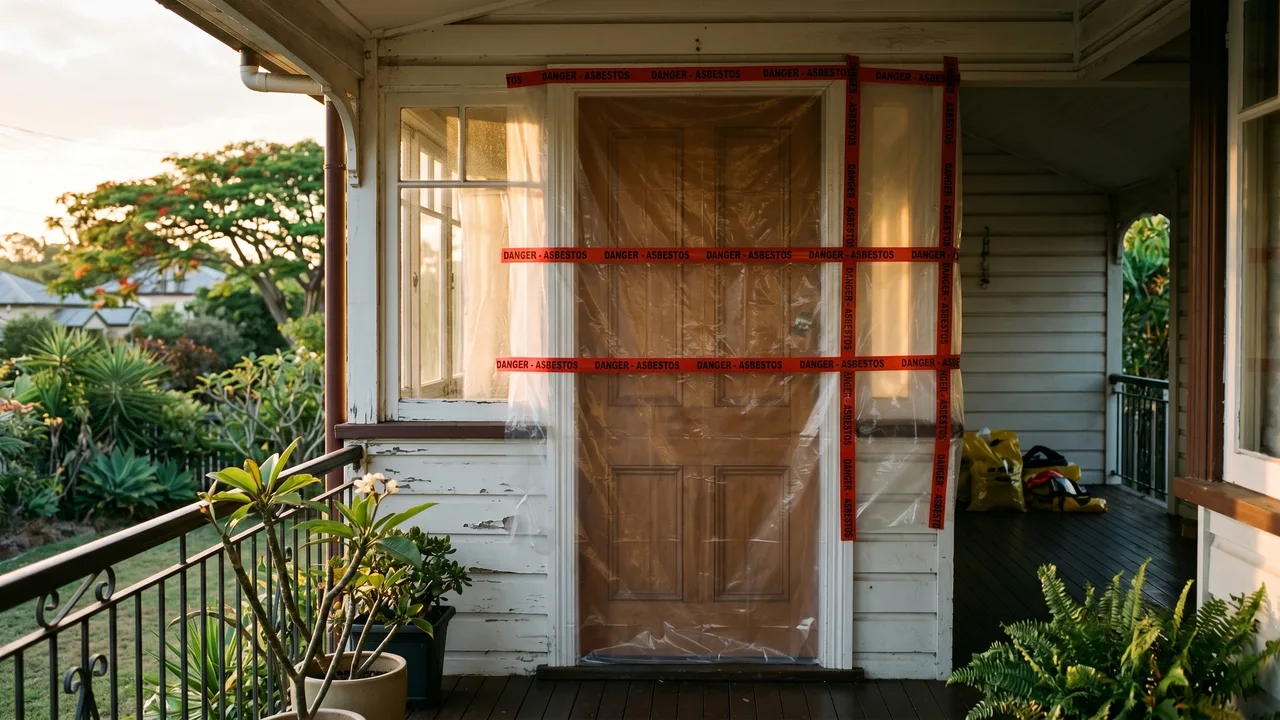
Asbestos Removal
Friable Asbestos Removal.
What Is Friable Asbestos and Why Does It Need Special Handling?
Not all asbestos is the same risk. Friable asbestos is material that crumbles, flakes, or can be reduced to powder by hand pressure. That's the dangerous kind. When fibres go airborne, they can be inhaled, and that's where the serious health risk sits.
Bonded (non-friable) asbestos, like flat cement sheeting in good condition, holds its fibres together. Friable asbestos does not. Old pipe lagging, loose insulation, badly deteriorated ceiling tiles, spray-applied fireproofing and some types of floor underlay are typical examples. In older Albany Creek homes, particularly those built before 1987, friable materials sometimes turn up in roof cavities, around hot water systems, in wall cavities behind original linings, and under vinyl flooring that has been damaged or removed carelessly.
Because of the elevated risk, Queensland law requires Class A licensed contractors to handle all friable asbestos removal. A Class B licence covers bonded materials only. This is not a grey area.
What the Physical Work Actually Involves
Friable asbestos removal is more involved than stripping a sheet of fibro off a wall. Here is what a typical job in Albany Creek looks like:
- The work area is fully sealed off with heavy-duty polyethylene sheeting and negative-pressure air units (sometimes called air scrubbers) to stop fibres migrating to the rest of the house.
- Workers wear full-face respirators rated to P2 or P3, disposable Tyvek suits, gloves and boot covers, and change out of contaminated gear before leaving the enclosure.
- The material is wetted down before and during removal to suppress fibre release. Dry removal of friable asbestos is not permitted.
- All waste goes into labelled, double-bagged or rigid containers, sealed immediately, and transported to a facility licensed to receive asbestos waste. In the Brisbane region, that typically means an approved Queensland EPA-permitted site.
- Once removal is complete, the area is decontaminated, and an independent hygienist typically conducts air monitoring and issues a clearance certificate before the enclosure is dismantled.
The clearance certificate (sometimes called a re-occupancy certificate) confirms fibre levels in the air are within safe limits. Without it, the area cannot be re-occupied.
When Does an Albany Creek Homeowner Need This?
You likely need friable asbestos removal if:
- A licensed inspection has identified friable material in your property (this is the right starting point if you are unsure).
- You can see asbestos-containing insulation that is visibly crumbling, powdering or falling apart.
- You are planning a renovation that would disturb a suspected friable area, such as a kitchen or bathroom gut-out in a pre-1987 home.
- A previous owner or builder has disturbed material and left loose debris.
- Storm damage or a roof leak has deteriorated materials that were previously intact.
There is no "season" for this work exactly, but summer storm season in South East Queensland can accelerate deterioration of roof-space materials. If your Albany Creek home has taken water into the ceiling cavity, it is worth having an inspection before assuming everything is fine.
What Does It Cost in Brisbane?
Friable removal costs more than bonded asbestos removal, and that is straightforward to explain: the equipment, the licensed personnel, the containment and the air monitoring all add up.
As a rough guide for the Brisbane region, small friable jobs (say, a section of deteriorated pipe lagging or a small area of ceiling insulation) typically start somewhere around $1,500 to $3,000. Larger or more complex jobs involving significant contamination or hard-to-access areas can reach $8,000 to $15,000 or beyond.
What moves the price:
- Volume and extent of the friable material
- Accessibility (roof cavity vs open room vs confined space)
- Whether air monitoring and a hygienist clearance report are included or quoted separately
- Disposal fees, which are charged by weight
- Decontamination requirements for the space afterward
Typically included in a quote: labour, PPE, containment, wet removal, bagging and disposal, and basic site decontamination.
Often quoted separately or as an add-on: independent air monitoring by a hygienist, clearance certificate, and any reinstatement work (patching, replastering, re-insulating) once the asbestos is gone.
Ask upfront whether the quote includes the clearance certificate. Some contractors include it; others treat it as a separate engagement with a hygienist.
Is This the Right Service for Your Property?
If you have not had a licensed inspection yet, that is the logical first step. An inspection and lab-confirmed testing will tell you whether the material is friable or bonded, which determines which licence class is needed and how much the job will cost.
If you already have a report confirming friable asbestos, then yes, you need a Class A licensed contractor. Attempting to remove it yourself is illegal for friable materials in Queensland and genuinely dangerous.
A Straight Note on Licences and Insurance
In Queensland, only a holder of a Class A asbestos removal licence (issued under the Work Health and Safety Regulation 2011) can legally remove friable asbestos. Any contractor you engage should be able to show you their licence number without hesitation. They should also carry public liability insurance relevant to asbestos work.
We connect Albany Creek homeowners with local contractors who hold the right credentials. If you want to talk through what your inspection report says, or get a sense of whether the scope of work sounds right before you commit, that is a reasonable conversation to start with a quick call.
Quick answers
Frequently asked.
What makes asbestos 'friable' and why does it matter?
Can I remove friable asbestos myself in Queensland?
How long does friable asbestos removal take in a typical Albany Creek home?
What is a clearance certificate and do I need one?
How much does friable asbestos removal typically cost in Brisbane?
How do I know if the asbestos in my Albany Creek home is friable or bonded?
Ready to book
Quickest is by phone.
Up-front pricing on the call. Booked in one go. No site visit needed.